


Debate 2: NDRP vs RPP
- The Grey Network
- Mar 28, 2023
- 4 min read


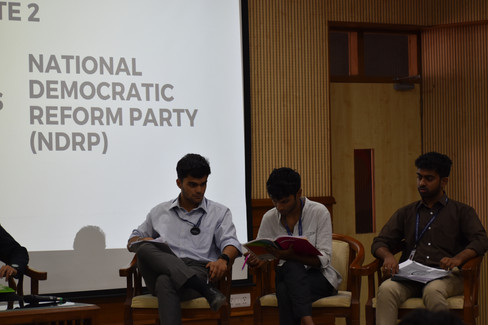


The second debate consisted of the National Democratic Reform Party (NDRP) and the Reformist’s People's Party (RPP). The first opening statement was given by the Party President Arsheeta Dutta Barauh of RPP where she briefly went through the party manifesto and spoke about the major reforms proposed by them like the medicare system, 2+2 language policy and the Euthanasia laws with consent of the patient at large. She claimed that the RPP is not just a party reforming a nation with policies but with an action plan. They aim to bring gradual changes. Moving on from this, there was no point of information and the NDRP moved on to their opening statement which was given by the PM Candidate Agni Tejas. He spoke about the four pillars of their party. He addressed issues like oppression of minorities, communalism, among many others that are prevalent in India and stated that their party not only looks at these issues but along with that takes care of problems which might not be acknowledged as problems like climate change. They believe in the principle of inclusivity.
RPP raised a point of information in which they argued that direct democracy voting with such a huge population does not make sense, how would it be valid and how do you think the public will accept it? The spokesperson Shreyas Vijay Nair of NDRP responded simply, saying that if every five years democratic elections can be held, why can't democratic voting be held every five years? This silenced the opposition and there were no further questions.
Followed by this, the main arguments were proposed. First, the RPP started off by saying that “All change is not reform”. They emphasized change, change for the betterment of the society, maximizing opportunities, and for social welfare where they shed light on social liberalism. They want to simplify business regulations. They stressed on their major flagship policies that is to promote a self reliant economy and raise the contribution of the manufacturing sector as well as protecting intellectual property rights. Next they took into account the right to health in the purview of Article 21. A point of information was raised by NDRP regarding the RPP’s language policy wherein they stated that their language policy was a direct copy of Mock NITI Aayog. They also questioned the party regarding the funds. They claimed that English being the first language in their language policy does not make sense in a country like India. The RPP answered by saying that they have used the vision which was proposed in the Mock NITI Aayog. Where the budget is concerned they stated that they planned to collaborate with private organizations in order to generate funds.
Next was the main arguments of both the parties, the NDRP started by bashing the so-called “radical system of governance” proposed by the RPP along with the skill development programs suggested by them in their manifesto. They argued that the reforms proposed by the RPP are similar to the past or even the current government's administration. The NDRP stated that unlike the opposition they have an extremely comprehensive plan that is evident in their manifesto itself. The RPP raised a point of information to the NDRP talking about the section of AFABS, raising the question whether women will get paid by their husbands? The NDRP answered by reading from their manifesto directly as they stated that the opposition party might have not gone through the manifesto properly as it was clearly mentioned in the NDRP manifesto “Socialization of household services at the UNION level pertains to building and staffing of daycare centers, canteens, preventative primary healthcare centers, health promotion centers, and laundries; Workforce of each of the public household service centers is to reserved in the following manner - 50% for AFABs and 50% for AMABs; ALL managerial positions in these institutions are to be reserved for AFABs for the first 5 year period, post which it shall be incrementally reduced by 10% with every passage of 5 years until it reaches 50%”
The Closing statement was given by the Vice President of RPP Dhruv Dass Puri who started by defending the policies that they proposed in their manifesto and stated that the policy of NADA is similar to that of NITI Aayog. In addition to this the NDRP raised a question asking the opposition, ‘’what exactly is the mother tongue of india?’’ The RPP fumbled at first but replied by saying that the regional language is the mother tongue and they further added direct statements from the manifesto by reading the 2+2 language policy directly from it. The NDRP’s closing statement was given by the Party President Sidak Singh Puri who closed by saying that the right to health bill of the RPP is copied from the Rajasthan Assembly and that the primary problem in healthcare is the quantity and quality of health not the access. The Party President ended by saying that the only good thing in the opposition's manifesto is the front page picture.

Comments